The Garden - nature’s dynamic meeting place
Stay curious, change your thinking and keep learning.
I am not sure whether I found the garden or the garden found me. The garden’s elusive nature, with its darker corners, sticky soil, tangled plants, and insect-filled nooks, made its hidden world feel instinctively familiar and welcoming. Before long, I was helping Mum and Dad with regular outdoor jobs around our home, and over time I branched out to help in our neighbours’ gardens. Through this hands-on learning, I came to believe that one of the main goals was to keep things neat and tidy. The reward was either a small payment or, even better, the satisfaction of restoring order for someone who appreciated the change because they could not achieve it on their own. Even now, one of the greatest rewards is stepping outside the next morning and seeing the previous day’s work with fresh eyes. After gardening for a while, I know that keeping a garden neat is not the main goal; there is more to the picture than the human need for order.
This neat mindset is closely tied to our sense of pride in place and home. While much in the wider world lies beyond our control, we can shape our immediate surroundings, and we often want them to reflect something of our own personality. A neat garden suggests the character of the person in residence. Even a messy garden tells a story about the people, not necessarily a bad one. Over time, my thinking shifted. I began to see how art and gardening could combine to create spaces that both nature and people can enjoy. Later, I continued to discover how to make gardens that belong to their surroundings, where the local landscape meets the garden and the garden contributes back to it, or even starts to rebuild it, garden by garden, where it has been lost.
Whatever our interests, we all have the chance to build on what we know and keep evolving. For me, life revolves around gardens, not just the work of making them, but the wider world they open up. Plants, soils, ecology, and design are only part of it; running a business brings its own lessons about people and systems. Over time, I’ve come to see learning as a continuous process rather than a destination. Where we begin and where we end can be very different, shaped by refinement and change. Some ideas fall away as we grow; others stay with us, waiting until we are ready to realise them. Staying curious, being effectively apprenticed to life, and not entirely making up your mind are what keep that process alive.
One idea that has stayed with me, as an ongoing question, is the role the garden can play in giving back to the environment rather than taking from it, as many other aspects of our lives do. This could be called regenerative gardening, or, better still, nature recovery gardening, both of which align with what I am thinking. It is a way of understanding the relationship between gardens and the natural world. Working with a naturalistic style offers a starting point, but the question remains: how can the garden help slow the impact of human existence? A garden can be far more than a collection of plants, a lawn, and a shed. Looking back to where my thinking began and forward to where I hope it will go, the garden is a dynamic meeting point between home and nature, a place where, given the opportunity, both will thrive.
Nature’s decline cannot be ignored. The loss and degradation over my lifetime alone are evident in both data and direct observation. These changes have been gradual, almost imperceptible at first, until they form a clear and undeniable picture. The environment is in deficit, and if the environment is in trouble, so are we. Each of us has a role in shaping the changes for the not-so-distant future generations. These changes go well beyond the garden; however, if the garden is a place we can start with, a place where we have a direct say, what are we waiting for?
Visiting Knepp
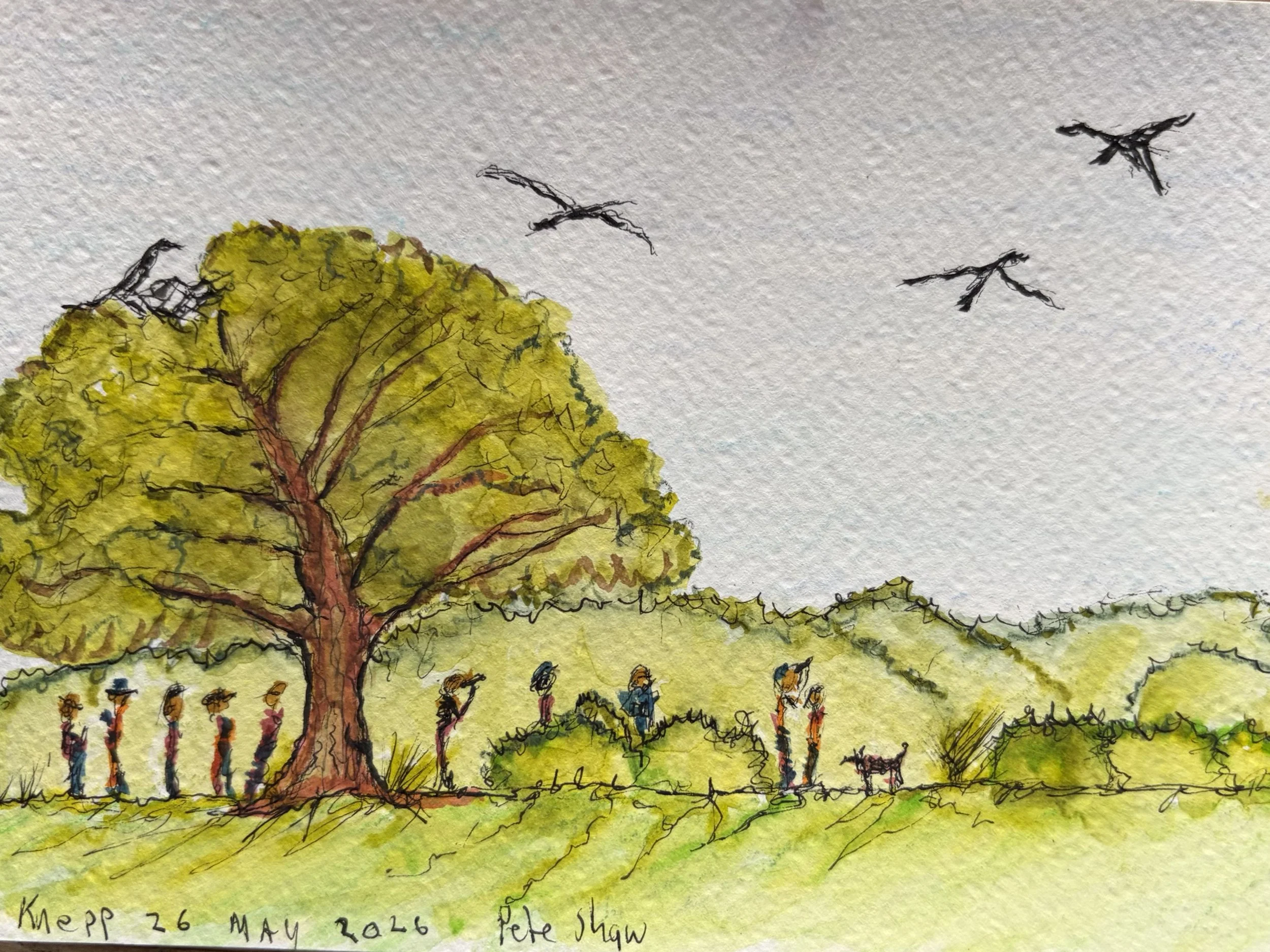
Knepp sits in the gentle Weald of West Sussex, just south of Horsham, where 3500 acres of rolling clay farmland. Intensive farming had already pushed this marginal land into decline through constant production, driving its local ecosystem to a breaking point. Economic pressures and climate stress only deepened the strain. It was the early 2000s when Knepp and its custodians faced ethical and business inflection points.
Isabella Tree and Charlie Burrell made a radical decision: they stopped trying to farm conventionally and allowed natural processes to take the lead. Courageously breaking generations of tradition.
Only two decades on, it proved to be a pioneering stroke of genius. Now, free-roaming cattle, ponies, pigs and deer shape a shifting, scrubby mosaic that may seem untidy at first glance yet is utterly alive, with nightingales, turtle doves and purple emperor butterflies returning in their own time. It is a huge garden having a conversation with nature: gentle, patient, ongoing, with success now measured by what comes back rather than what comes out. If you need nature-rich proof, look at what has happened here and how quickly. With wingspans wider than most cars, storks soar overhead. In the treetops, giant stick nests sit, looking out over the fields. The prehistoric creatures chatter with a clacking noise, and all this makes you feel as if you might be in Jurassic Park. Beaver dams riddle the waterways, confounding humans by building them right where they want and then moving them just because. Nature's engineers at work, transforming waterways and altering the landscape, offering countless benefits no civil engineer could ever achieve.
Walking quietly beneath the trees and through the scrub, the land feels vividly alive, moving beyond something managed into a self-renewing system where people, animals, and insects share a natural rhythm. Birdsong and insect movement fill the air, creating a constant, shifting conversation. The landscape shows both challenge and resilience, with old oaks bearing witness to drought and heavy rain, and new life emerging everywhere, from bramble protecting young birch to tiny, grazed oaks sustaining strong root systems, ready to flourish when conditions allow.
Human presence feels part of this balance rather than separate from it. People move with care and curiosity, shaping their actions in response to the land. As we sit and hear the story, I notice the river, then something drifting down, and realise it’s a person who had entered the steady, clean stream further upstream and was drifting with the flow. Later, as I walk around, small groups of people are returning to the campsite where this water journey can begin. There is a quiet interplay between observation and intervention that gives the whole place strength. As I walk, I am reminded to simply be present. One foot may lean towards what lies ahead, the other grounded in what has passed, but it is here, in the present, that an in-person understanding forms, as steadily as the land itself continues its recovery.
As you might expect, the new Knepp was initially met with resistance from the community and neighbouring farms, many of whom have since been persuaded by clear results to join the movement. Even so, Knepp’s work feels as though it is only just beginning. While I had read about the regeneration and seen it on film, experiencing it firsthand made the transformation unmistakably real, revealing a landscape that is deeply alive and fully conveying the scale and impact of what Isabella and Charlie have set in motion. I can't even imagine what the next two decades will bring as the next generation takes the reins and carries this story into the future.
As a gardener and aspiring change-maker, I explore how the gardening world can respond to climate change. How something like Knepp and the home garden can meet. A powerful macro example that can be applied at a micro scale. It encourages a shift in perspective that can influence how we design gardens and how we work with those who entrust them to us. From there, changes in thinking can spread and, over time, contribute to something much larger.
I am not offering a simple how-to, nor suggesting that rewilding every garden is the answer, or that it means simply stepping back and doing nothing. There is a richer meeting point between rewilding and the garden, one we can all explore and play with. Even though I can hold two ideas at once - the neat, designed garden and the freer, nature-led garden - they can overlap rather than oppose one another, inviting us to work with what is already alive around us.
I invite you and me to step into that space with curiosity. Question what you know, be open to changing your mind, and seek a middle ground between what you enjoy and what you may hesitate to allow. Read, observe, visit, and quietly experiment. Let your garden become not just something you shape, but something you join, growing into a place that nourishes both nature and the human heart.
Further
I have always liked David Whyte's poem Sometimes, particularly the arresting line: "stop what you are doing right now, and to stop what you are becoming while you do it." This seems to be exactly how Isabella and Charlie responded to Knepp's inflection point.
SOMETIMES by David Whyte
Sometimes if you move carefully through the forest, breathing like the ones in the old stories, who could cross a shimmering bed of leaves without a sound, you come to a place whose only task is to trouble you with tiny but frightening requests, conceived out of nowhere but in this place beginning to lead everywhere. Requests to stop what you are doing right now, and to stop what you are becoming while you do it, questions that can make or unmake a life, questions that have patiently waited for you, questions that have no right to go away.
There are many books on habitat-friendly gardening; one that comes to mind is AB Bishop's Habitat - A practical guide to creating a wildlife-friendly Australian garden.
Peter, June 2026
Routeburn, The Flats
On the bus from Queenstown I met a young Brit, fit as they come and full of energy, bright eyes. Good looking, tanned, the Antipodean life treating him well in New Zealand. He was working for a year in the emergency department at a hospital on the North Island, 2-3 years out of medical school in the UK. He paused when I asked him about his work. Solemnly he recalled the large number of car crash accidents, in a remote community where locals drove old cars without wearing seat belts. He didn’t have much leave from work, so had booked to tramp all three of the Fiordland Great Walk trails in 5 days. 2 days per trail, on trails that themselves were recommended to be walked in 3-4 days each. Perhaps after the horrors of the ED he wanted to absorb as much nature and wild beauty as possible in the short time he had. A solo walker like me, but on Fiordland trails that were a United Nations of walkers from around the globe, all seeking some experience of the wild, the beauty of Nature. Some there, for sure, for the adventure or fitness challenge or selfie for the socials. I saw that young Brit again, walking the Routeburn the opposite way to me with at least two days walking in front of him which he would do in one day. He would probably miss the Routeburn Flats, but hopefully absorbed enough beauty to carry him through the grim months ahead in the ED.
I am an older tramper now on the trails. I say tramper as I’m hiking in New Zealand. Hiking , rambling, walking in other places. There are some older solo hikers, knees supported with bandages, and some parents with teenage child, a last attempt to share an experience, connection, before the child became an adult, independent and possibly distant, in place and perhaps emotionally. Most of the trampers were young, fit, and yes surprisingly blonde, out to walk NZ from Germany, the Netherlands, Holland. Many were university students on the holiday of a life time, taking a year out and travelling through Asia, Australia, New Zealand the Pacific.
I have always walked, not extreme or adventure hiking, but walking, in remote locations yes, but really to be in Nature, to be away from the city, to slow myself to the rhythm of walking and escape for a while the race of modern life, multiple emails, social media, constant noise. In Northern Queensland, Tasmania, the Victorian alps and coast, and further afield in Japan, Costa Rica, Italy and Papua New Guinea. I walked to be quiet, to get perspective, to experience the potential of the trails. Tails leading to somewhere new, somewhere where effort was needed, body exerted.
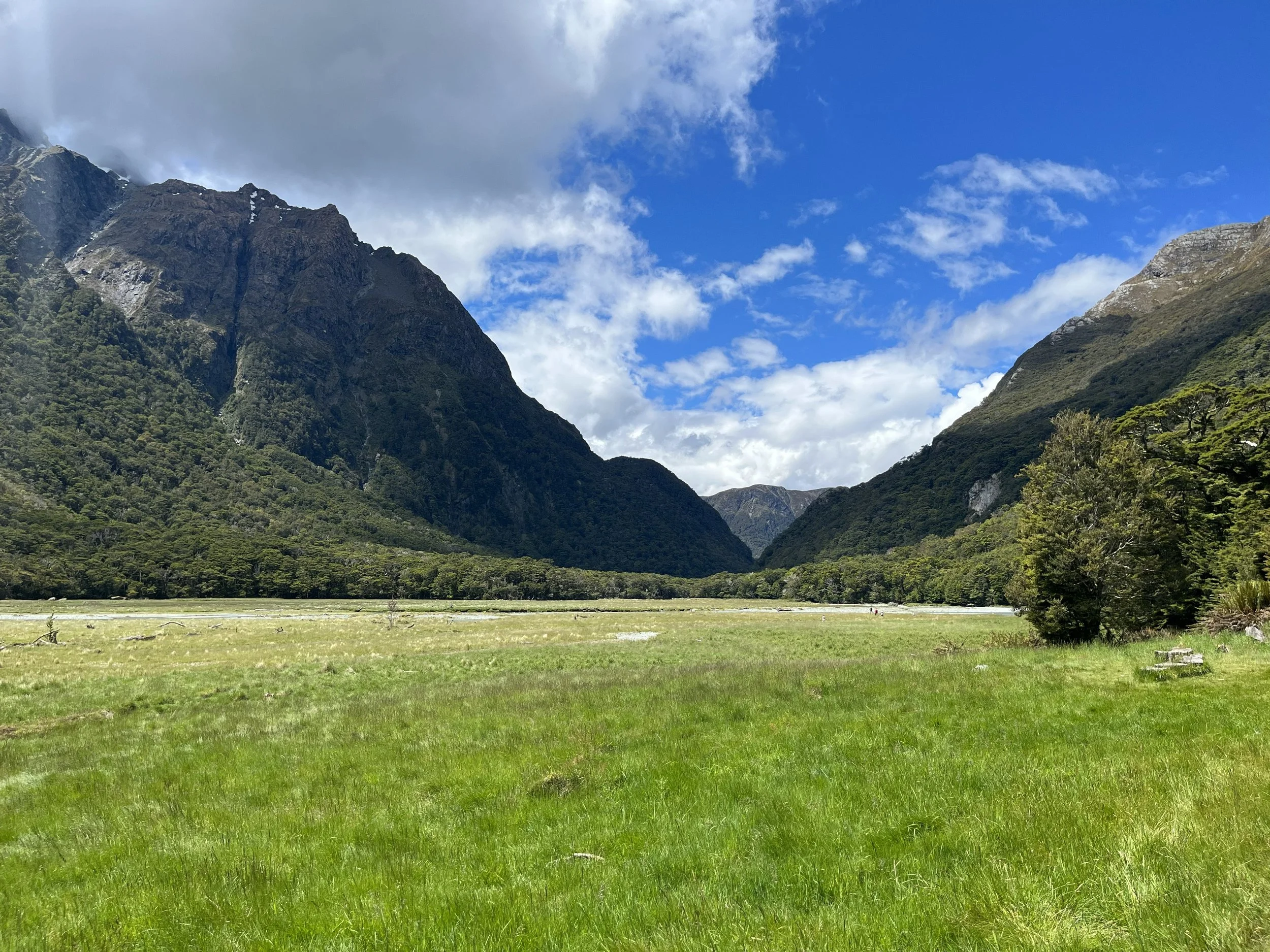
Arriving at Routeburn Flats, I think it is, probably, the most beautiful place I have ever been. And that is saying a lot after the Dolomites, the Japan Alps, bits of Switzerland. No phone reception here, pictures will help tell the story, but I also had to write this down. Brings to mind Annie Dillard , Aldo Leopold, Muir, Thoreau. Routeburn river meandering, rolling across stones, water so crisp, clear and cold, standing waist deep, healing for my weary hips and legs. Rolling out to join the Dart River, Te Awa Whaktatipu, and then to Lake Wakatipu, and on its shores Glenorchy and then Queenstown. Ducks slowly but deliberately feeding on insects, reeds in the river shallows, taking their time, honking away, no predators here. Ducks, that is, the Blue Duck /Whio, Paradise Duck/Putakitaki, one of each.
A view across the Flats of waving grasses and yellow daisies, to massive snowcapped peaks, sun glistening off the rocks and bright against the deep white snow. To my right the snowcapped peaks of the Humboldt Mountains (with Summus, 2293m and Momus, 2148m) and to my left the Serpentine Range, with Mt Erebus (1978m), and Mt Xenicus (1912m) , with a waterfall splitting the green banks of trees and rocky cliffs on the lower reaches of the range. Some of these mountains named after Greek gods. Must research who named them. Summus , god of nocturnal heaven, Momus, God of mockery & complaint, Erebus , god of darkness and shadow. Makes sense. Xenicus , not a Greek god but rather after the New Zealand rock wren or pīwauwau ("little complaining bird") in Māori. The view of the mountains changing all the time as the clouds shift. A view down the valley as the river runs to the Bridal Veil Falls which I passed on the way up. The walk up from the shelter and beginning of the Routeburn track, along the river, with the valley slowly revealing itself, what it ultimately revealed I did not expect.
Mark (written December 2022, posted May 2026)